Cape Town
7 February - 20 March 2026Penny Siopis
Love in a Turning World
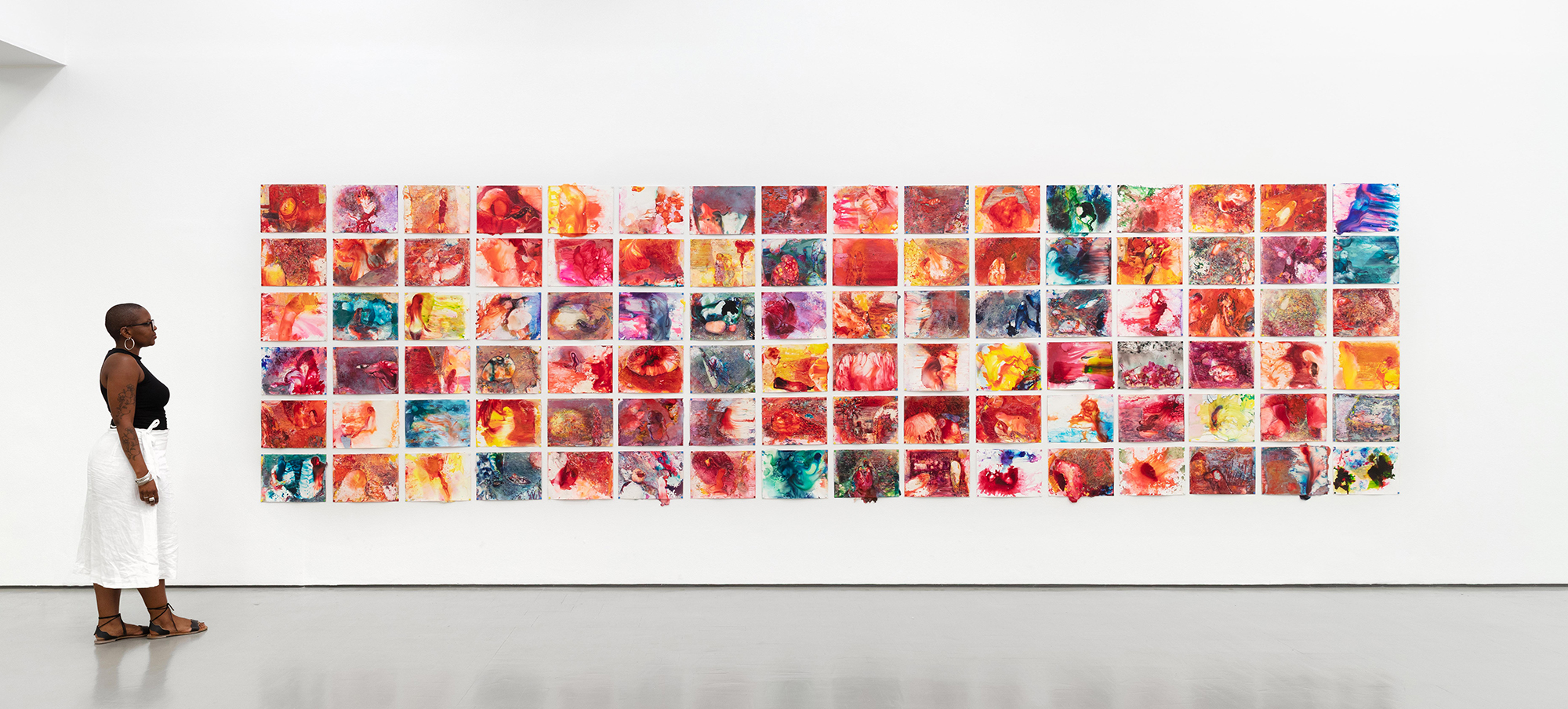
Penny Siopis, Atlas, 2020-ongoing, glue, ink and oil on paper, 96 pieces
STEVENSON is proud to present Love in a Turning World, a solo exhibition by Penny Siopis, her first with the gallery since her acclaimed retrospective For Dear Life at the National Museum of Contemporary Art Athens (EMST) in 2024/25.
In this exhibition, Siopis brings to the fore the idea of love – as a position or disposition, rather than as pictorial subject (although suggestions of embracing figures and birth abound). Love is posited as a way of being in relation: to others, to the non-human, and to a world experienced as unstable and in flux. The notion of ‘turning’ operates across multiple registers, speaking to current global and psychological states of tumult, as well as to the processes of transformation inherent in the artist’s materials and method, in which form, meaning and emotion remain open rather than fixed. As Siopis reflects:
A cruel world we are in, and it is hard to see sometimes how traumatic rupture is also a condition for the birth of the new. Open form is suggestive, hopefully, of this. We see what we see as pigments explode and come together. Anything is possible in the imagination. Antonio Gramsci’s famous line feels resonant here: ‘The old world is dying and the new world struggles to be born...’
Over the past two decades, Siopis has developed her improvisatory, call-and-response mode of working with glue and ink, recognising the agency of her materials, the way they interact with gravity and the elements to generate visual incidents to which she reacts. Materiality, she notes,
manifests through form – the open form of fluid glue and ink deposits on canvas and paper, and my response with visceral oil paint, some thick surfaces calling for sgraffito; new things happen in the scratched surface. Conversations ensue, mostly tender, sometimes harsh, between all the elements – colours are born through chemical reactions of pigments in fluid states of becoming; fiery luminous streaks couple with swathes carrying minute specks. The white canvas pulls. Colour is a vital intense material force. It is bodily in how it shifts experience of painting from its optical character to the sensation of touch. Non-verbal. Emotional.
Glue and ink change as they dry, turn transparent, and settle unpredictably into the surface, producing marks that hover between abstraction and figuration – potential images that invite imaginative projection. Siopis continues:
In ambient light, strange dimensionalities occur across surfaces – some glue and ink shapes appearing watery and waxy, blurring boundaries with the canvas skin, while others sit in relief on the canvas face, paint crustiness catching the light. Everything seems in perpetual motion, not only between figure and ground, and what pushes forward and what recedes within the bounded space of the painting, but in the eye of the spectator. There are enormous and intimate worlds. Things turn every which way…
In the front room, an installation of Atlas paintings proliferates. Conceived during the pandemic and presented in large groups at EMST and the 12th SITE SANTA FE International, these small works on paper reference the ‘Mnemosyne Atlas’ by art historian and cultural theorist Aby Warburg. While Warburg’s collection of images hinged on his research into the afterlife of antiquity, Siopis approaches her mass of pictures in line with her investigation into painting’s potential as open and empathic form. As the artist notes, each painting ‘is its own world and simultaneously an essential part of the larger world – the community of images – it shares and shapes with the others.’
In the main gallery, open-form canvases are joined by a group of sculptural assemblages created from found objects. In their ‘foundness’ these objects with their inherited symbolism speak in a different register, but coherence is deliberately unsettled; items are brought into intimate and strange relation, opening space for imaginative projection and free association. This sense of porousness extends across the paintings too. Ambiguous figures appear to flee or seek reprieve; others articulate states of ecstasy, tenderness or quiet embrace.
Throughout Love in a Turning World, love and grief are closely intertwined. For Siopis, who has worked before with grief, both personal and global, they are inseparable, ‘joined at the hip’. ‘Love holds so many possibilities, especially in relation to grief,’ she reflects. ‘As in the refrain “every grief story is a love story”, or the other way around. Intimate and beyond. There is a lot to say about love, not least love as a form of resistance.’
Affirming humanity and affection in these times of trouble and precarity, Siopis’s work insists on openness: to vulnerability, uncertainty, and the possibilities of new forms of relation coming into being.
The exhibition will open on Saturday 7 February, 10am to 1pm, and will be on view during the Cape Town Art Fair. A book of Siopis's Atlas paintings will be launched at the time of the fair.

