Cape Town
28 March - 9 May 2026Mahesh Baliga
the shape of her bite
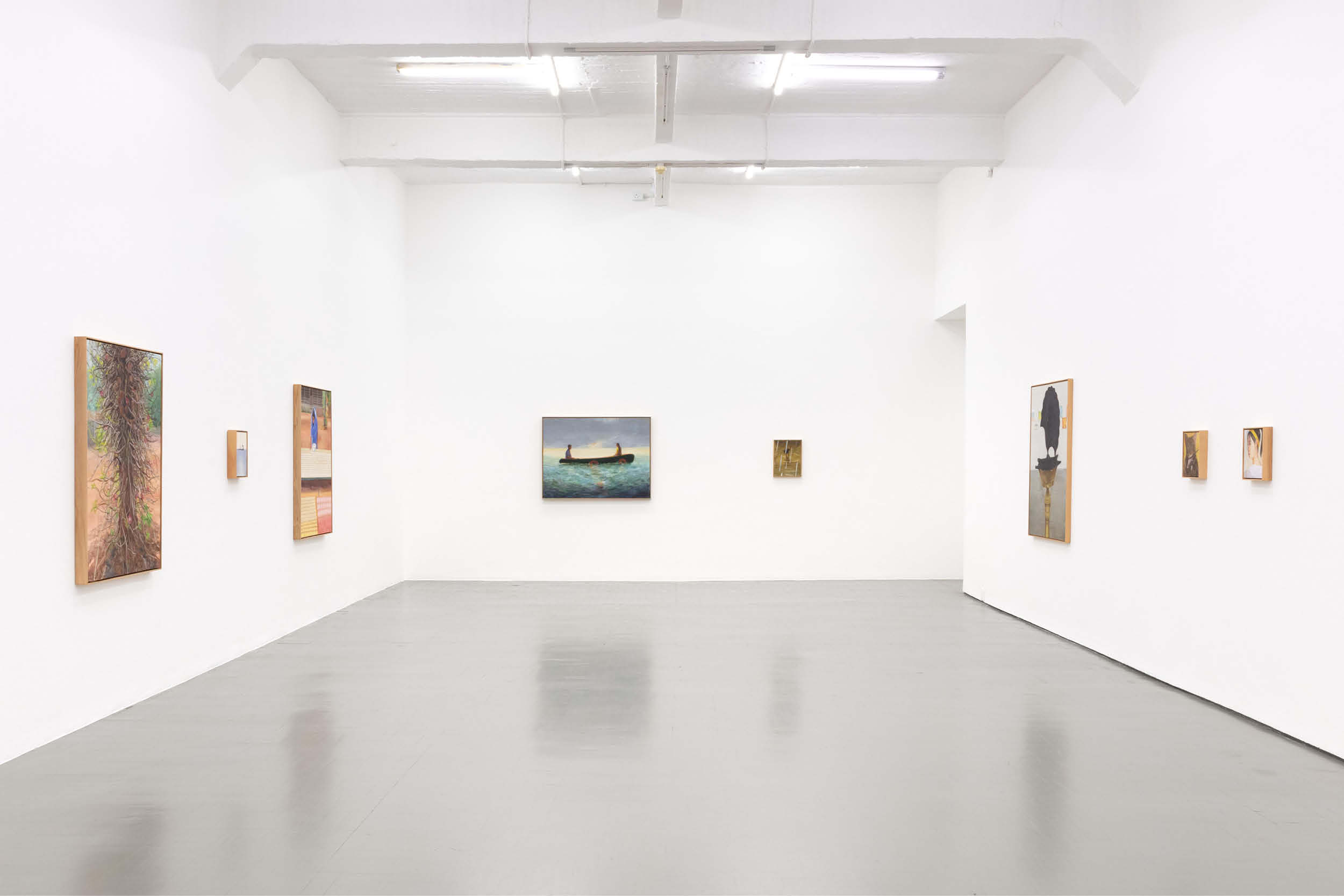
Mahesh Baliga, the shape of her bite, 2026, installation view
When she left me
after lunch, I read
for a while.
But I suddenly wanted
to look again
and I saw the half-eaten
sandwich,
bread,
lettuce and salami,
all carrying the shape
of her bite.
— 'Still Life' by AK Ramanujan
STEVENSON is pleased to present the shape of her bite, a solo exhibition by Mahesh Baliga, the artist’s first with the gallery. Baliga shows new paintings in casein tempera on canvas, board and wasli paper.
Baliga lives and works in the city of Vadodara (formerly Baroda), where he undertook his postgraduate diploma in painting at the Maharaja Sayajirao University. The institution is known for having birthed the ‘Baroda School’, which brought together western modernist genres with traditional Indian representational styles, creating a narrative figuration movement focused on contemporary stories. Prominent artists associated with the school include Bhupen Khakhar, Gulammohammed Sheikh, Sudhir Patwardhan and Gieve Patel.
Baliga recollects, in an interview with Subha De, how Patwardhan and Patel would do lengthy studio visits while he was a student, and later visit his exhibitions. In 2012, he recalls, ‘Patel came the morning before the show opened, and looking at the work he said, “there's a lack of emotion” … And I didn't understand anything about that, I had no experience … But in 2014, when I lost my mother, somehow I realised what he was talking about. I think that changed everything in my work. Earlier it was my own pain, then slowly it became anybody's, that I would reflect on. And the work's starting point became the pain, the suffering …’
Love and loneliness, perception and the passage of time come to the fore in the shape of her bite, furthering Baliga’s preoccupation with what he terms ‘the ignored everyday’. For the artist, it’s the small actions and rituals ‘so normal they are overlooked’, that give ordinary life its extraordinary quality. Longing appears in many forms: thwarted, displaced, consumed by fire, traced in the marks left on a neck. Animals feature as proxies, their captive or precarious conditions held in quiet correspondence with the human.
Baliga’s medium of casein tempera, a binder derived from milk, combined with natural mineral pigments – lapis lazuli, cinnabar, malachite – is associated with the Indian miniature tradition. The paint is applied to canvas, board or wasli, a traditional handmade paper comprising several layers pasted together and burnished to a smooth surface. For Baliga, casein ‘offers elusiveness and the filmic to the images’, working to emphasise the atmospheric quality of his scenes, his loose washes of colour brought to depth by a precise configuration of tonalities rather than the arbitration of line. This quality is inseparable from his subject matter, in which the clearly seen dissolves into the imagined, and observation and longing are intertwined.
Baliga writes:
The search for the presences of long-forgotten things and people, the wearing away of desires, the defined journeys that lost their destinations — all keep appearing. The passage of time changes how things exist: objects once valued lose their aura and lie abandoned. Thoughts race over choices not made.
What arrives from the distant past endures as different stories. The artist himself becomes a participant: he exists both as a practitioner and as a being entangled in various relations. The works lay out quests about how things are seen and perceived — how the precarious position of an animal becomes an object of reflection, and how an image of fire carries the idea of longing and suffering.
What is so simply remembered loses its earlier meaning. Something dreadful translates into love; an act of domestic labour turns out to be an existential struggle. The small travels to his workspace on a flooded day speak of small acts of love.
The apparent transmutes: the softness of love, fearful symmetries, fading pain — all of which might have been contemplated by the lonely painter waiting for a warm meal with an empty plate.
The exhibition opens on Saturday 28 March, 10am to 1pm, concurrent with a solo exhibition by Moshekwa Langa.

