Cape Town
28 March - 9 May 2026Moshekwa Langa
Proxies
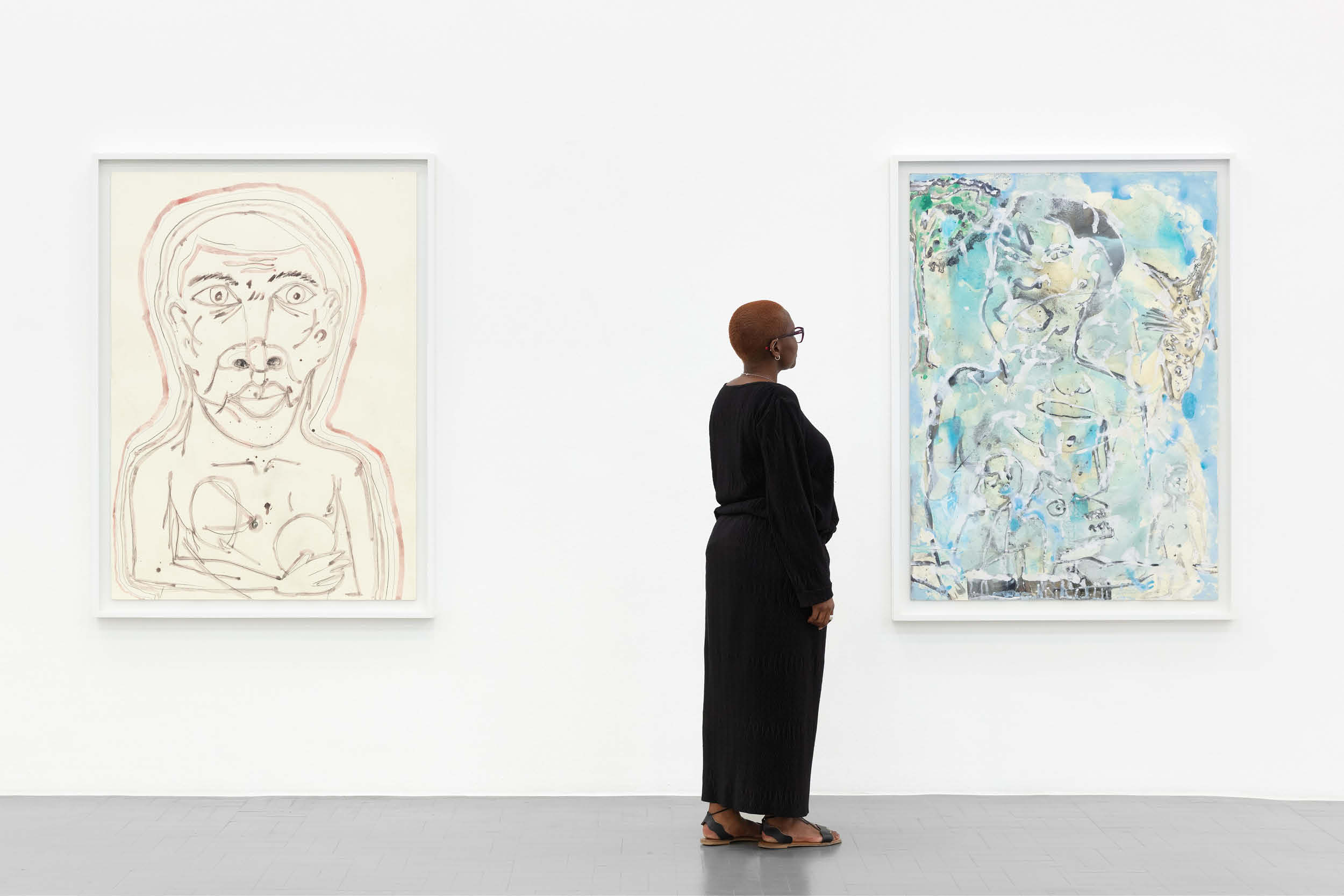
Moshekwa Langa, Proxies, 2026, installation view
STEVENSON is pleased to present Proxies, a solo exhibition of new work by Moshekwa Langa, marking a decade since his first solo with the gallery in Cape Town in 2016.
From the outset of his career in the 1990s, and throughout his rise to prominence in the 2000s, Langa has been associated with a freewheeling form of artmaking that employs unconventional materials to lyrical ends, his elliptical treatment of his subject matter turning interiority into what art historians have called [‘an] intimate kind of liberating lostness’. Across Proxies, Langa continues in this vein, elaborating on the themes of familiarity and estrangement that have marked his work over recent years, offering new reflections on how memory, imagination and presence function in a psyche’s efforts to locate itself in place and time. The artist writes:
I take solace in solitude, I can reflect and refract and mull over things, write notes. A society that refuses to recognise your very presence and to recognise you’re there - but also requires you to participate in everything as though everything is fine - creates a series of unbelievable breaks. This brings a lot to think about, to describe, to say, and to be ignorant of. No longer here, no longer there, unheard, unseen, but well noted at the same time. It is something to examine. One finds ways to go around all those situations. I create universes that allow me to refocus on something outside of my immediate concerns.
The works on paper in this exhibition were chiefly created over the last two years in Langa’s Amsterdam studio. They collapse distinctions between figuration and abstraction as well as moments in time; some works are prompted by his daily life, others by instances of travel, and others still by events in his childhood in Bakenberg or as a schoolboy in Pretoria. The dogs, trees, cars, landscapes and topographies that characterise the artist’s lexicon recur here in a spectrum of oblique and concrete renderings, the tone of his visual anecdotes echoing that of his reflections. He continues:
The cars, the cows, dogs, figures and thorn trees, they point to different passions and experiences, loss, security, uncertainty. I used to go gather firewood. We lost a young black calf once, I guess it was stolen. We had to go to the veld in search of it after school. It was never found. Dogs bit me, I feared dogs. I had two beautiful dogs that I doted on. They died and I never had them replaced. We had donkey carriages to deliver water and sand, echoes of a more bucolic timeline perhaps. I think about some of these things. The distance that grows vast as I am no longer connected with all this, but which was also a defining factor. I no longer feel the need to tell a story, perhaps to stir up and evoke a feeling of maybe disquiet, unsureness.
The introspection in Proxies is mirrored by the presence of portraiture in this body of work. Langa presents two sets of images, one on white paper, from a series titled Sleeper Agents, and another, titled Gravity, on paper painted black. While both depict figures with inscrutable features through pathways of lines, the former – created with ballpoint and graphite – are said to depict visitors, strangers and messengers holding ‘perhaps a light, perhaps a clue to a new direction’. In the latter, Langa’s mixed-media technique is attuned to the tension of the figures, creating images of spectres that simultaneously reflect and absorb light, about which he says, ‘they are proxies, they are translucent. Ghostly even. They are not me and I am not them.’
Proxies highlights Langa’s continued experiments with material and form. To make these works he turned his studio into something of a pool, using hot days to amass pigments, fragments and adhesives on the floor, creating an imprint of time and movement, then adding materials from grocery shops and hardware stores, allowing his surfaces to densify into a record of his curiosities. He explains:
Last summer I made a differential swimming pool in my studio, decidedly dependent on glorious hot and summer days to dry everything. I simply trusted the process. The pool started off blue, then gradually there was a build-up of hues. I always adding new sections in different colours that blotted the paper beneath, from thence I reworked the surfaces into something new, more tempered. Sometimes the canvas stuck to the paper, sometimes I used off-cuts from fabric shops that brought in beautiful, serrated patterns. Later I would work on the paper in full view, making adjustments and corrections, adding to the swaying waves already imprinted.
I like to bring texture through experimentation with building materials like powdered Polyfilla that cakes into stones when used – it creates wonderful absorbent surfaces. Sometimes I bring coffee grounds. I like to layer colours slowly and thinly to build up a variegated pallet. Some are thickly overlaid and it becomes difficult to create other layers, so one works according to the limits of the bumpy surfaces. It is a way of compounding histories but without specifications. Indeed, the results ended up looking like bird’s eye views of a rolling landscape. One sees spectres floating through a myriad undefined spaces, figures surrounded by a semblance of trees, natural elements that denote day and night, never really explicitly signaling if it is night or day. It is a map and a surface and a legend. It is a poem.
There is something about being in a zone where you are in concert with your material. I laid out my concerns a long time ago, my quest to define my own space while still being a participant in divergent societies, this thing of place, territory, belonging, erasure. I describe what I see and maybe dream about, I think this is a valid form of a creative life.
The exhibition opens on Saturday 28 March, 10am to 1pm, concurrent with a solo exhibition by Mahesh Baliga.
Click here to inquire.

