Cape Town
16 May - 27 June 2026I keep coming back here, I don't know why
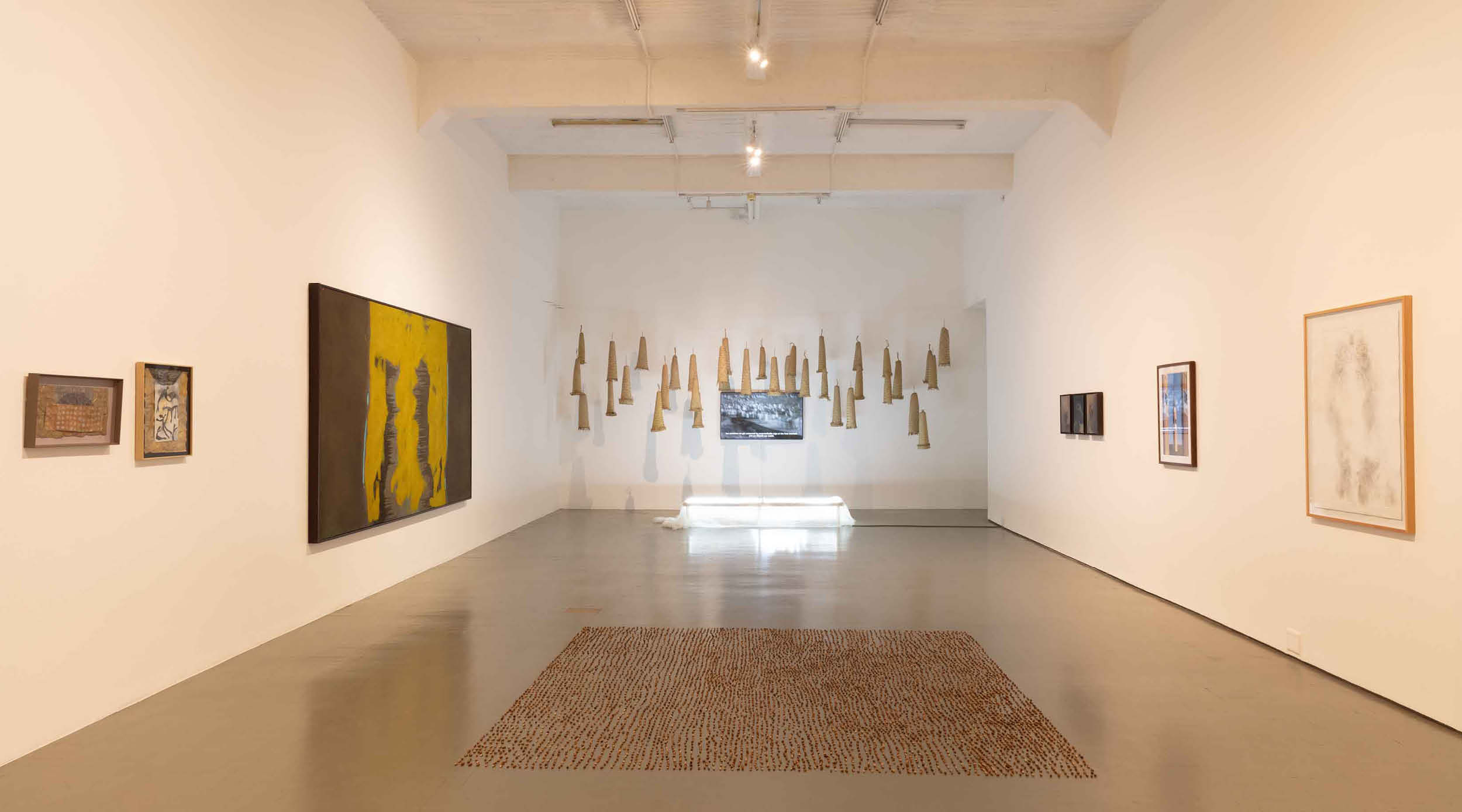
Installation view, I keep coming back here, I don't know why, 2026
STEVENSON is pleased to present I keep coming back here, I don't know why, a group exhibition curated by Aza Lithalethu Mbovane.
The exhibition considers the act of returning: to forms, to knowledge, and to stories that persist even when their origins are indistinct. In 1969, Kenyan Philosopher John S. Mbiti conceptualised the ‘unlimited past’, an understanding of African time which describes the phenomena as constantly expanding across the past and present, a time that is never finished. I keep coming back here, I don’t know why responds to Mbiti’s proposition of temporality as cyclical and consequential by offering a non-linear approach to history. The exhibition circles questions regarding what constitutes a record, probing if it can be described as a feeling, register or event. The participating artists explore the compulsion to chronicle tangible moments alongside the creation of metaphysical timestamps, which reveal to us the delicate sensibilities that feed personal accounts.
Paintings by both Katlego C. L. Twala and Farhana Jacobs offer discussions of matrilineal dynamics. Twala’s tender oils on linen, drawn from old family photographs, trace connections between maternal figures pictured beside trees, and Tswana idioms that liken women’s resilience to nature’s rootedness. Jacobs, in turn, continues her inquiry into the irrevocable relationship between women’s bodies and landscapes; Before Sujood I depicts entangled figures, exploring this relationship’s intergenerational inflections.
Moshekwa Langa’s unseen AIR HAS MASS and Untitled (both dated 2000), recall his first and last encounter with a beach in the Netherlands, which led to sunburn-induced fever. In this moment of frenzy, his mind returned to the phrase ‘air has mass’, which he learnt during his early primary school years in Bakenburg, Limpopo, following the introduction of English into the curriculum. These works, like many in Langa’s practice, outline the collision of memory, feeling, and fact.
Siyabonga Mahlaba contemplates and revises the colonial architecture found in the Dutch Reformed Church of Africa through a fusion of photography and narration; in It Is Omnipresent, the church buildings in his hometown of Bethlehem in the Free State, are manipulated and collaged into digital dreamscapes. Mawande Ka Zenzile and Zainab Choonara demonstrate devotion as anchors for spiritual understanding. Choonara’s etched prayer mats, smudged in charcoal and imprinted by her physical form, consider the repetitive and dense constitutions of Islamic commitment. Toward the Kaara continues this gesture, composed of date seeds collected by Choonara during prayer and seasons of fasting. Ka Zenzile’s oil paintings, mixed with cow dung, are an extension of his work as a spiritual healer. Listening to the thunder (after Peter E Clarke) emerges from a body of work that explores painting as ritual, driven by an urge to ‘experience the intuitive beyond the rational’.
UMqombothi, uBhokweni neJuba, an artistic research project and installation by Russel Hlongwane and Tammy Langtry, examines how Durban’s apartheid-era system of interlinking laws banned the private production of African sorghum beer (enjoyed both leisurely and during ancestral rites) and how its monopolisation catalysed the women-led Beer Hall Boycotts of 1959 across KwaZulu-Natal. iGama Lami uPhumzile wakwaNkosi! (1959-2023), the short film forming part of this installation, juxtaposes found footage with one participant’s testimony, exposing the erasure of women whose protest spearheaded the system’s eventual demise. In INGWE, Siyababa repurposes the Zulu textile that adorns traditional clan totems, and fashions it into a mannequin with an exaggerated phallic form. The artist interrogates the overlap of Zulu hyper-masculinity (laden with an inherited culture of aggression) and its use as a shield for homoerotic impulse.
Yonela Makoba and Kamva Matuis observe the complexities of how traditions shift through time. Matuis’ enigmatic still-lifes comment on the harsher realities of black inheritance, often actioned through the passing down of broken homes, clothing, and rituals that morph as they are relayed. Makoba subverts feminised ways of communing through foregrounding the ritual of iTi as ceremony, using teabags as her medium. Mankebe Seakgoe and Balekane Legoabe position mark-making as a limitless code capable of transcending time, space, and language. Seakgoe’s meditations on her own relationship to silence and sound unfold as intuitive, poetic forms across painting and sculpture. Legoabe’s drawings, reminiscent of rock paintings, lean into the potency of collective histories through scenes of enmeshed creatures that speak to our relations with the innate and primeval.
As part of the exhibition’s opening, Yonela Makoba presents an iteration of her performance, Silibonile iZilanzi l’kamama estoepini (we have seen my mother’s river snake on the stoep). Moving through Woodstock, the artist will take a meditative Butoh walk guided by the Xhosa Methodist hymn 360. This will be livestreamed in the gallery from a living patch of grass. The work considers the memories of occurrences and their connections to specific landscapes can take form as monuments.
The exhibition opens on Saturday 16 May, 10am to 1pm, concurrently with Jo Ractliffe's solo show, The Garden.

